
Click Move Box
A lesson in worst practice.

WORST PRACTICE
“I am an arms dealer, fitting you with weapons in the form of words.”
- “This Ain’t a Scene, It’s an Arms Race” Fall Out Boy
Click. Move. Box.
Have you seen this new educational website that’s revolutionizing classroom engagement, exploding cognitive growth, and skyrocketing academic achievement? We are getting our steps in for this one! It’s called Click Move Box. Here’s how it works:
Students log into this proprietary edtech website (of which we have no oversight) where students get a set of boxes with words in them. There’s also a bunch of empty spaces for the boxes to go. The student has to click the box, and then - and this is the important part so pay attention - move the box into an empty space. Are you seeing the utility of this in your classrooms yet?
Don’t worry - if the student puts the box in the wrong space, the website has special technology to send the box back where it came from, so the student can try again! Forever! Until they get it right! No need for reteaching, the student gets to trial-and-error as much as they need to learn where the box should go!
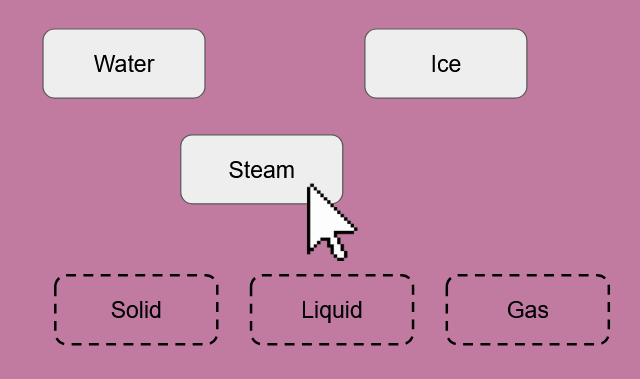
Click Move Box in action!
Do you teach math? Science? Grammar, or social studies? Doesn’t matter! You can put any words inside the boxes! It’s a truly universal tool in the modern classroom. And if you get the paid version (they have three plans, starting at $10 a month for “Preferred” and going all the way up to $50 monthly for the “Chumps” plan) you can even change the color of the boxes, share your Click Move Box with coworkers, and give students an in-depth level up system for their in-game avatars (called “Movers”) which will create hours of screen time in the classroom! Engagement!
Why is this crap ubiquitous in our profession now?
Seemingly every-other PD is “the new game that will change your classroom” or “three tips to engage students.” And we know that “engage” is a not-so-thinly veiled code for “entertain.” We’ve allowed our craft to be subsumed by bigtech brain worms and social media trends. What happened to “practice this until you get it, then we test to see if you get it”? You know, how all of us went through school? Those ancient traditions of practice and challenge are the reason we are (mostly) capable (mostly) well-adjusted adults.
Teachers are not entertainers. Now, some of us are entertaining; and that’s a bonus for the classroom to be sure. Getting the kids to laugh or see things in a new way can be critical. It certainly makes the lesson easier to get through. But why have we allowed this obsession with “engaging lessons” to become a competition of whose bespoke activity gets the most shares on TikTok, or gets mentioned in the next district PD?
Click Move Box encompasses all of these new edtech games… yes, even the one you like. And we can admit, we had our favorites too. How easy is it to just set the kids on a computer and let them “engage” themselves, or whatever it is they’re doing over there. We have real work to get done, and now that the kids are pacified and we can fill out those IEP forms or plan the next Click Move Box lesson.
There’s a derogatory name for this behavior when parents do it. Many of us judge it when we’re at a restaurant or out in a crowded place.
Ipad kids.
Parents who can’t be bothered to interact with their children, can’t be bothered to teach their kids how to act in public, refuse to impart how to be a functioning human being - they just stick their kid on a jumbo ipad with a U.S. military-grade protective case and move on with their day. Or a hastily queued up youtube video on a parent’s phone can suffice if the ipad got left at home. And without fail that ipad or phone is on full volume just so that you know how engaged their child is.
We shake our heads at this in public, and yet we allow our classrooms to mimic this pacification behavior. Classrooms across America have gone all-in on computerized learning; a quick web search finds data that 80% of schools nationwide have technology assigned to students 1-to-1. Over 57% of schools nationwide incorporate daily computer use, with an average of 50% of student instructional time spent online.
Is there a single teacher out there who can honestly say students are getting smarter as a result? Hell, is there anyone out there that can honestly say that students even know how to use the fucking computers better than we do? Ask a kid - any age - to type in a URL instead of typing something into Google. Go ahead, try it. Watch how their brain malfunctions and you realize that URLs, save icons, and file management are things of the past. The future is now old man, and it’s up in the cloud. Your dumbass is still living down on planet Earth.
And we see this in our PD sessions. It seems that no matter the district, the trainings always have the same condescending tone. Students are scoring lower on average each year? Students can’t do basic tasks we could do at the same age? Well the problem must be you and your teaching, not the countless screen time in their life. How will we solve this problem? More screens, and more entertaining engaging lessons are the answer.
So sayeth the person who hasn’t taught in a classroom in years and got out as fast as they could to avoid these kids.
So sayeth the administration who is more concerned with negative reviews from parents than actually running the school effectively.
But we’re not entertainers. We’re educators. And no one ever learned a single thing from taking a box and moving it to a different box, over and over, until eventually they get a green check mark that says “great job!”

Okay fine, maybe this Move Box is worthwhile.
Reject Click Move Box. Return to analog, practice-based classrooms where the mind is at the center of the lesson, not a screen.
So at your next all staff meeting, have some lines prepared…
I’m here to teach kids, not to entertain them.
You and I learned to read, write, and do basic math without edtech games.
Research points to negative connections between developing brains and screen time, in any form.
-
Teach with Integrity, or Not at All
Guerrilla Teachers of the World.